What Is Stretching in Thai Massage?
Stretching in Thai massage involves a massage provider supporting and gently guiding different parts of the body through gradual movements. Unlike stretching on your own, it includes hands-on support rather than requiring you to make every movement yourself. You still take an active part by noticing how you feel and communicating during each movement.
The focus is not on making a stretch deeper or wider, but on moving within a comfortable range. There is no need to match an example you may have seen, as comfort can differ from person to person. Even with similar movements, the range that feels right need not be the same.
If this is your first visit, remember that having someone support you does not mean you should let a movement continue without speaking up. If a stretch feels too intense for comfort, you can ask the provider to slow down, reduce the range or stop. Staying aware of the pace and communicating throughout may help you feel more relaxed during Thai massage stretching, without setting a target for how far you should move.
An Example: Supporting the Leg as the Knee Bends
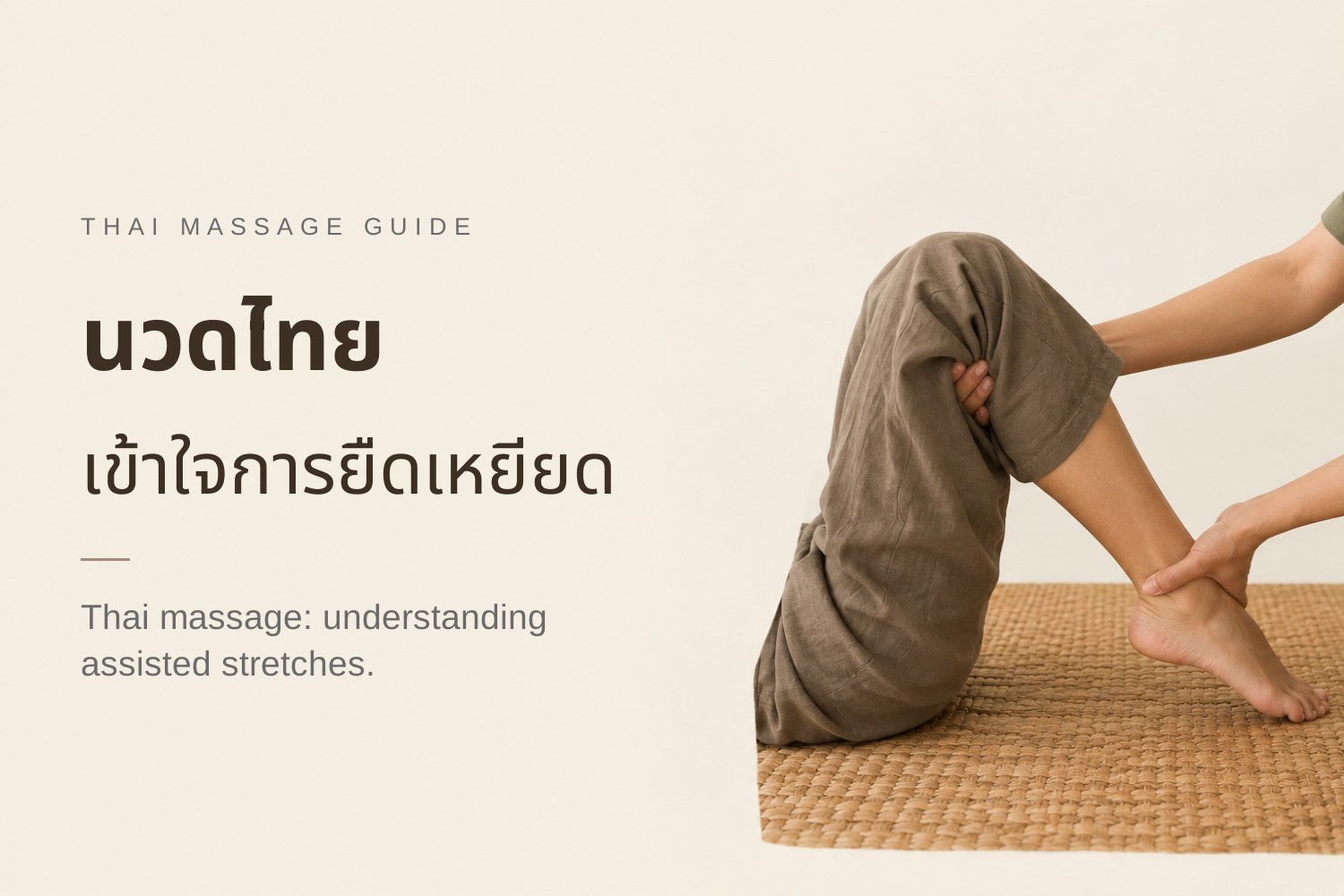
Imagine one leg supported by hands beneath the knee and at the ankle. As the knee slowly bends, the supporting hands carry the weight of the leg through the movement. This example shows that stretching is not simply about guiding a leg into a position; it also involves support along the way.
You can notice whether your leg feels supported and how gradually the movement progresses. A flowing movement does not mean continuing without pauses. There should be room for you to share how you feel and ask for a break. There is no need to tense your leg in an effort to make the movement look wider.
As the knee bends, sensations may change with the position of the leg, so speak up when you begin to feel uncomfortable rather than waiting until the movement ends. Comfort and communication matter more than the angle of the knee or how far the leg can move. This example of support is intended to explain the general nature of Thai massage stretches and what to notice, rather than provide steps for practising them on someone else.
Why Support and a Slow Pace Matter
Stretching in Thai massage involves both support from the massage provider and gradual movement of the body into a stretch. For example, when supporting the leg and bending the knee, supporting the part of the leg being moved means you do not have to hold it up yourself. This may help the movement feel more comfortable.
A slow pace gives you time to notice how the movement feels as the knee first begins to bend and as it bends further. You can ask for a smaller range of movement, a slower pace, or a stop without waiting until the stretch is complete. Movement should progress gradually according to how you feel at that moment, rather than aiming to bring the leg to a particular position.
Pressure and stretching are separate elements, even within the same massage experience. Pressure focuses on applied force, while stretching focuses on movement and range. Intensity should therefore not be the measure of whether a stretch suits you.
Within a comfortable range, you may feel more relaxed with the movement. However, each stretch may feel different. Support and pace should be adjusted to how you feel, rather than increasing the force or range each time a stretch is repeated.
How to Communicate During Stretching
During stretching, try using short, clear phrases to describe both where you feel a sensation and what you would like adjusted. For example, you might say that the stretch feels tighter as your knee bends and ask for less movement. Identifying the point where discomfort begins helps the massage provider understand which part of the movement to adjust, without needing technical terms.
- Please go a little slower so I can notice how it feels.
- Please use a smaller range of movement. This is starting to feel uncomfortable.
- Please stop this stretch and let me rest in a comfortable position first.
There is no need to push yourself, tense up, or hold your breath to match someone else's stretch. If you feel uncomfortable, speak up straight away and ask to stop that movement. You do not need to wait for the massage provider to ask or finish the stretch before explaining how it felt.
Even if the movement feels comfortable at first, you can ask for an adjustment along the way, as the sensation may change when your leg moves further. After an adjustment, say whether you feel more comfortable or would still prefer less movement, so the support can reflect how you feel at that moment.
What to Ask About Stretching Before Trying Thai Massage
Before choosing a service, ask whether it includes Thai massage stretching and what kinds of movement are involved. A service name alone does not describe every movement, so ask how your legs may be supported, your knees bent, or other parts of your body moved. The sequence may not be the same every time.
Another useful question is how to skip a movement or ask to stop while it is underway. If stretching is unfamiliar to you, you can ask the massage provider to explain each movement before starting. This gives you a chance to share how you feel and decide whether you would like to try it.
Explain your preferences for pressure and range of movement separately. For example, you might prefer light pressure and want to begin with a small range of leg movement, since pressure and stretching can feel different. During the massage, you can say when you begin to feel tightness, ask for a slower pace, or request a pause. There is no need to push yourself to reach a particular position. Comfort varies from person to person, so clear communication matters more than how far you move.
If you would like to try it yourself, Kham offers Thai massage (Heavy) 60 min.
Frequently asked questions
How does stretching in Thai massage differ from stretching on your own?
In Thai massage, the massage provider supports and guides parts of your body through a movement. When stretching on your own, you control the direction and range yourself. Assisted stretching therefore calls for ongoing communication about tightness and comfort throughout each movement.
What is the role of leg support when bending the knee?
Supporting the leg during a knee bend helps carry its weight and guide the movement gradually. The massage provider should move slowly and adjust the range to your comfort, without forcing the knee to bend further.
Do I need to stretch through a wide range to feel relaxed?
A wide range is not necessary, as everyone's comfortable range of movement is different. Stretching without forcing the movement, at a slow pace and while breathing normally, may help you feel relaxed. There is no need to compare your range with anyone else's.
What should I tell the massage provider if a stretch feels uncomfortable?
Speak up immediately about where you feel uncomfortable and ask for a smaller range, less pressure, or a pause. For example, you could say, “Please stop for a moment; the back of my leg feels too tight.” You do not need to endure discomfort or wait for the stretch to finish. Resume only when you feel comfortable and ready.
What should I ask about stretching before choosing Thai massage?
Ask which parts of the body will be stretched, how you will be positioned, and whether stretches you find uncomfortable can be adjusted or skipped. You can also ask how the massage provider will support your legs and adjust the range of movement. Before starting, explain which areas you do not want stretched and agree on a signal to stop.